Vape battery charger: the reference sheet
A lithium ion vaping cell stores a considerable amount of energy inside a cylinder a few centimetres long. A vape battery charger is the device that decides how quickly that energy goes back in, and above all when to stop. It is that end of charge decision, invisible to the user, that separates dependable hardware from doubtful hardware. This sheet gathers the verifiable figures and the documented conditions of use for a British reader.
What a vape battery charger actually does
A charger takes an 18650, 20700 or 21700 cell from its working voltage up to its maximum charge voltage, then cuts off. The two reference points are stated by every cell manufacturer without ambiguity: a nominal voltage around 3.6 or 3.7 V, and a maximum charge voltage of 4.2 V for the chemistries used in vaping.
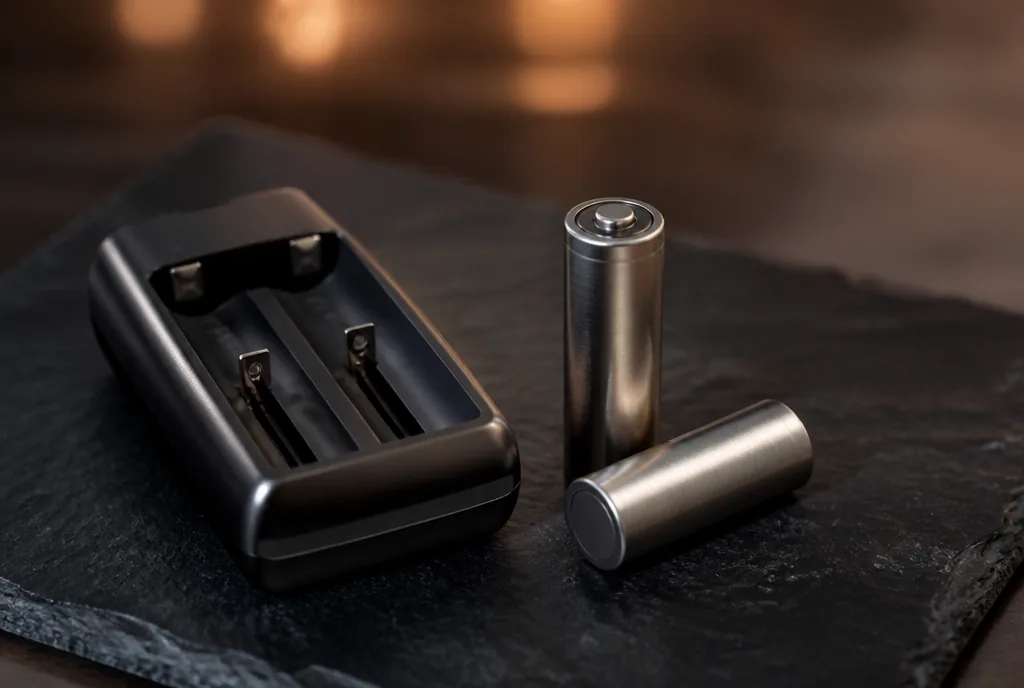
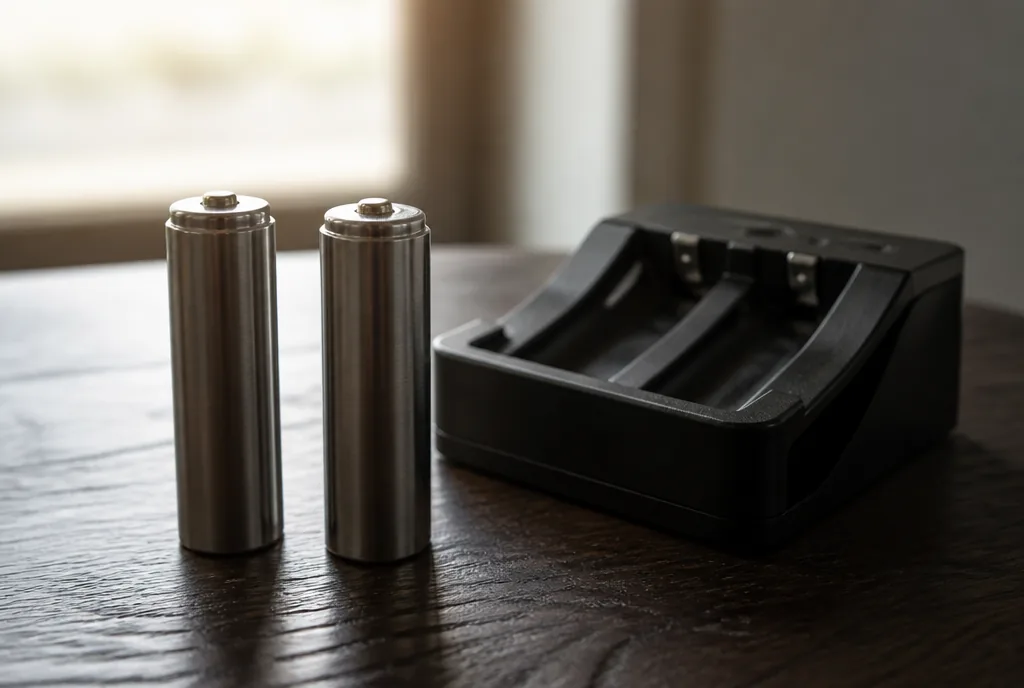
The whole difficulty is the cut off. A competent unit detects end of charge per cell rather than for the tray as a whole. The distinction is usually written into the specification as an independent charging circuit for each bay, and the brands stocked by British specialists, Xtar, Nitecore, Efest, Vapcell and Gyrfalcon among them, state it plainly on their own pages.
That independence conditions everything else. Without it, two cells of different capacity or different wear placed side by side finish charging at the same instant, which means one of the two finishes badly. On a matched pair used in a dual cell mod, that difference shows up after a few dozen cycles.
Charge current is read on the cell, not chosen by feel
The current expressed in amps is not a comfort setting. It is tied to the size and the chemistry of the cell you are charging, and the correct value is the one the cell manufacturer publishes on its own datasheet, expressed as a maximum charge current for that exact reference.
The method matters more than any number. You identify the cell by its full code printed on the wrap, find the maker’s datasheet for that code, and read the maximum charge current and maximum charge voltage stated there. A figure printed on generic packaging, quoted in a shop listing or repeated in a forum thread is not documentation and should not be treated as one.
Product pages let you check the charger against that reading before you buy. Selectable currents are common on current units, and multi bay models usually share a total output between occupied bays, so a unit rated at a headline figure often delivers a fraction of it per bay when every slot is full. Reading the per bay figure rather than the headline is the single most useful habit in the category.
Choosing a vape battery charger: the criteria that count
Bay count, the range of formats accepted and the power supply make up the bulk of the decision. Portable and desk use do not lead to the same object, and it is better to settle that question before comparing anything else.
Bay count follows your hardware. A vaper running a dual cell mod needs to charge one pair while using another, so two bays is the practical minimum. Four and eight bay units exist and belong on a worktop rather than in a bag.
The range of formats accepted decides how long the unit stays useful. A charger limited to 18650 becomes dead weight the moment a 21700 mod enters the collection, and units covering 18650, 20700 and 21700 in the same cradle cover almost everything currently sold with removable cells.
Charge state display runs from a single indicator LED to a four step gauge, up to an LCD or TFT screen showing voltage and real current. The screen does not improve the charge in any way, it simply makes what the unit is doing verifiable rather than assumed.
Finally, the supply. USB units draw from whatever source you already own and add no mains block to a crowded socket, while units with an integrated mains plug regulate their own supply and depend on no unknown adapter.
What charging inside the mod does not replace
Recharging through the USB port on a mod is convenient, but it is not the same electrical operation. In a dual cell mod the input current is shared between the two cells, so each one receives roughly half of the figure printed on the box.
The second gap is thermal. Charging generates heat, and a cell enclosed inside a sealed chassis sheds that heat less well than a cell sitting in a ventilated bay. An external unit simply works in better dissipation conditions, which is one reason the charging port on a rugged single cell kit is usually described as a top up rather than a main route.
The third gap is balancing. A mod charges a pair as a single assembly, a multi bay unit treats them one at a time. On cells that do not have exactly the same wear, that difference becomes visible after a few dozen cycles, and it often surfaces first as a low battery warning arriving too early.
Discharge is the cell’s business, not the charger’s
This is the point most often inverted. The charger determines how the cell is filled, but the power you can draw afterwards depends solely on the continuous discharge current the cell manufacturer publishes for that reference.
Reading that value is a discipline rather than a calculation. High capacity and high current capability pull in opposite directions within the same format, so a cell advertised on capacity alone tells you nothing about what it will tolerate under load. The nomenclature stamped on the wrap is where the identification starts, and the datasheet is where it ends.
UK framework, transport and end of life
A vape battery charger sold in the United Kingdom falls under the UKCA and CE marking regimes and under the waste electrical equipment rules. The cells themselves fall under the waste batteries rules, and many British retailers that sell batteries take used ones back, alongside household recycling centres.
Air travel is the other regulated moment. Rules applied by airlines require spare lithium cells to travel in the cabin and to be protected against short circuit. A rigid case per pair meets that requirement, a jacket pocket with a set of keys in it does not.
Three habits appear in every technical source and none of them costs anything. Keep away from both extremes of the charge window rather than sitting at either end. Check the wrap, the insulating plastic sleeve, on every handling, since a split sleeve exposes the metal can that sits at the negative pole and turns any contact with the positive terminal into a short. And charge on a non combustible surface, never on a bed or a sofa, with the unit in sight.
Frequently asked questions
Can two cells from different brands go in the same charger?
On a unit with independent charging circuits, each bay works separately, so the question does not arise as it does inside a mod. Cells that work as a pair in a mod, however, must stay matched: same model, bought together, always used and recharged together.
How long does a full charge take?
It depends on capacity and on the current selected. A rough order of magnitude is capacity divided by current, plus roughly twenty percent for the final constant voltage phase, during which current tapers off.
Can a charger recover a completely flat cell?
Some models advertise a wake up function that restarts a cell that has fallen very low. It does not restore lost capacity and it does not replace changing a cell that has reached the end of its life.
Should cells be taken out of the mod for storage?
For long storage, yes. It avoids the slow drain caused by electronics left live and removes any chance of the fire button being pressed in a bag. A rigid case is essential as soon as cells leave the device.
Mains socket or a computer USB port?
A computer port delivers less current, which lengthens the charge without making it gentler in any meaningful sense. Units with an integrated mains plug regulate their own supply, which is more legible than depending on an unknown adapter.
What to check before buying a vape battery charger
A vape battery charger is judged on three lines of its specification: independent charging circuits per bay, a format range covering your current and future mods, and a selectable current you can match to the datasheet of the cells you actually own. The rest, screen, travel format, finish, is comfort.
The reference values, a nominal voltage near 3.7 V and 4.2 V at end of charge, let you verify for yourself that the unit is doing what it claims. Everything else follows from reading the cell manufacturer’s own documentation rather than a listing, and that habit is worth more than any feature on the box.
Editorial content for adult readers only. Vaping products usually contain nicotine, a substance that causes addiction. Not for sale to under-18s in the United Kingdom. This article is not a buying recommendation.