Batteries low: what the warning means
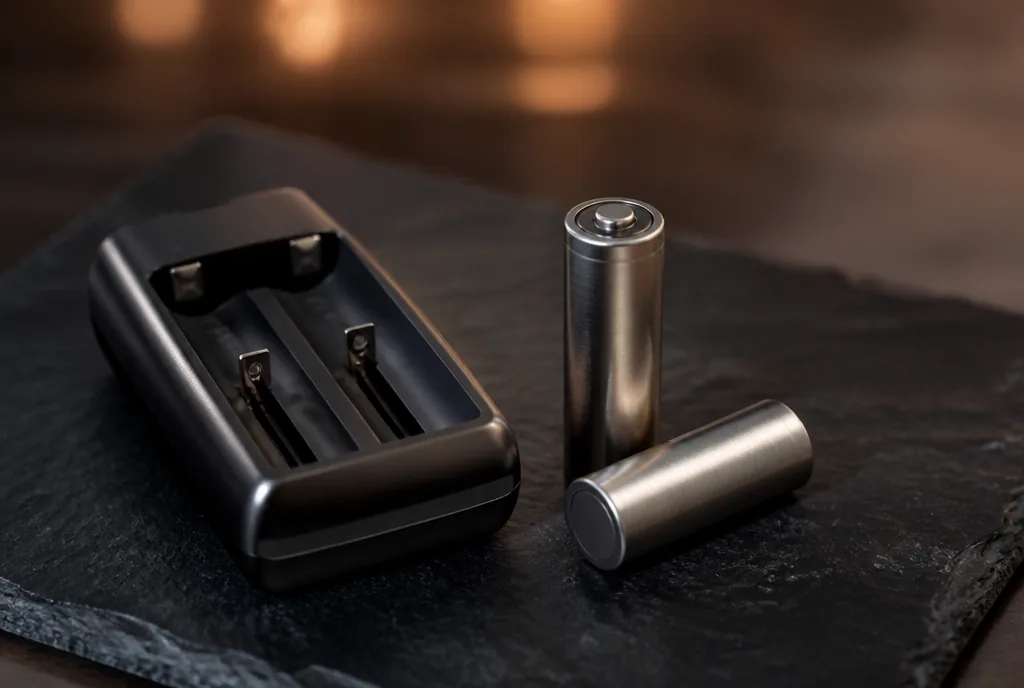
The batteries low message always turns up at the worst moment, and the first instinct is to plug the device in. In a fair number of cases that changes nothing: the warning is back after a handful of puffs. The reason is that the mod is not measuring what most people assume it is measuring. This benchmark explains what the circuit actually watches, and in what order to work through the possible causes.
Batteries low reports a voltage, not a percentage
A vape mod has no idea how full a cell is. It measures a voltage, compares it against a threshold set by the chipset, and raises the alert when the value drops below that line. There is no fuel gauge inside a lithium cell to read.
The two reference points are documented by every cell manufacturer: a nominal voltage around 3.6 or 3.7 V and an end of charge voltage of 4.2 V. Between those two figures the lithium ion discharge curve is very flat, then it falls away sharply at the end of the run.
That profile explains the sensation of a sudden cut. The device spends little time in the zone where the indicator visibly drops, and a great deal of time in the zone where it barely moves at all. What feels like a broken gauge is simply chemistry behaving normally.
Why the message comes back straight after a charge
This is the most disconcerting case, and it has a straightforward electrical explanation. A worn cell holds a respectable voltage at rest but collapses the moment a serious current is asked of it.
When you press the fire button, the coil draws heavily for a few seconds. The voltage sags below the alert threshold for the length of the puff, the mod shows batteries low, then the voltage climbs back as soon as you release.
That signature points to internal resistance that has risen too far, which is another way of saying the cell has reached the end of its life. No setting corrects the behaviour. Only replacing the cell makes it go away, and on a device with a sealed battery that means replacing the device.
The causes, in order of checking
There are five common causes, and they do not cost the same to rule out. Working through them from the cheapest to the most expensive avoids replacing hardware that was never at fault in the first place.
The first is simply that the power being drawn has gone up. A lower resistance coil, or ten more watts on the dial, changes consumption immediately. The same cell will last noticeably less time without being defective in any way.
The second is an incomplete charge. A damaged cable, an underpowered adapter or a dirty port can interrupt charging before it finishes, and the mod then raises an early warning on a cell that genuinely is not full.
The third is age. Accumulated cycles reduce usable capacity and raise internal resistance. On a mod with removable cells the replacement is limited to the cell itself, while on a device with an integrated battery it concerns the whole appliance.
The fourth is dirty contacts. A film of liquid or dust on the metal contacts degrades conduction and skews the measurement. A dry clean on a switched off device is enough to eliminate that possibility in under a minute.
The fifth is the charging circuit itself. If cells tested in another mod behave normally, the fault lies in the device rather than in the cells. That cross test is the most informative of the lot and it costs nothing at all.
Removable cell or sealed battery: the diagnosis diverges
The same message does not lead to the same action depending on how the device is built. That distinction is the first one to establish, before looking for any cause.
On a mod with removable cells, the cell is a consumable. It can be tested, replaced singly if it works alone, replaced as a matched pair if it works alongside another, and taken to a battery collection point at the end. The device itself is not implicated by the ageing of a cell.
On a pod with a sealed battery, the cell is soldered in. No cross test is possible, and a repeated alert after a full charge generally marks the end of life of the whole unit. That is a criterion to weigh at purchase, not at the moment of failure.
Batteries low and the other messages on that screen
The low battery alert belongs to a family of English language messages that mods display, and it helps not to confuse them. Each one names a different measurement taken at a different point in the circuit.
Check battery or Battery error reports an anomaly in the cell or its contact, not simply a low charge. No atomizer, Check atomizer and No coil detected all concern the coil circuit at the top of the device instead.
Low resistance and High resistance mean a value outside the band the mod accepts. Overheat concerns temperature, and Lock means the fire button has been deliberately disabled, often by the slider or sensor lock built into a rugged mod.
What reduces how often it appears
Two documented habits noticeably cut the frequency of the alert, and both concern how you charge rather than how you vape. Neither costs anything to adopt.
The first is the charge window. The advice repeated across manufacturer and retailer documentation is to avoid running a cell right down and to avoid holding it at full charge, and some recent mods now include a setting that caps charging below the maximum for exactly that reason.
The second is the charging hardware. In a dual cell mod limited to a modest input current, that current is shared between the two cells, so each one receives roughly half. A charger with independent bays treats each bay separately and detects end of charge cell by cell instead of stopping both at once.
Two further habits belong here because they cost nothing. The wrap, the plastic sleeve insulating a cell, gets a visual check on every handling, since a split sleeve exposes the metal can that sits at the negative pole. And cells travel in a rigid case rather than loose in a pocket with keys or coins.
Frequently asked questions
Can you keep vaping once the message shows?
The device still works, but delivered power becomes irregular and a deep discharge does lasting harm to the cell. Charging is better than running the reserve to the bottom.
Do two cells have to be replaced together?
Yes. A pair works matched, which means bought together and always used together. Replacing only one creates an imbalance between the two, at charge as well as in use.
How many cycles does a vape cell last?
No universal figure can be given. It depends on the model, on the current drawn and on charging habits. The cell manufacturer is the only acceptable source on that point, on its own datasheet.
Can a sealed battery be replaced?
Rarely in practice on current vaping hardware, since the cell is soldered and the casing is not designed to be opened. It is worth treating a sealed device as a single unit with a finite life.
Where do you take a dead cell?
To a battery collection point. Many British retailers that sell batteries take back used ones, and household recycling centres accept them. A cell never goes in general household waste, even fully discharged.
Batteries low: the reflex to keep
The batteries low message is a voltage measurement, not a verdict on the device. Showing up at the end of a long day, it is normal. Coming back a few puffs after a full charge, it names a cell whose internal resistance has risen and which needs replacing.
The cross test in another mod separates the cell from the charging circuit in a couple of minutes, and identifying the cell by the code printed on its wrap is what lets you check its manufacturer datasheet rather than a shop listing. On vaping hardware, most power faults read this way, by isolating one element at a time.
Editorial content for adult readers only. Vaping products usually contain nicotine, a substance that causes addiction. Not for sale to under-18s in the United Kingdom. This article is not a buying recommendation.